


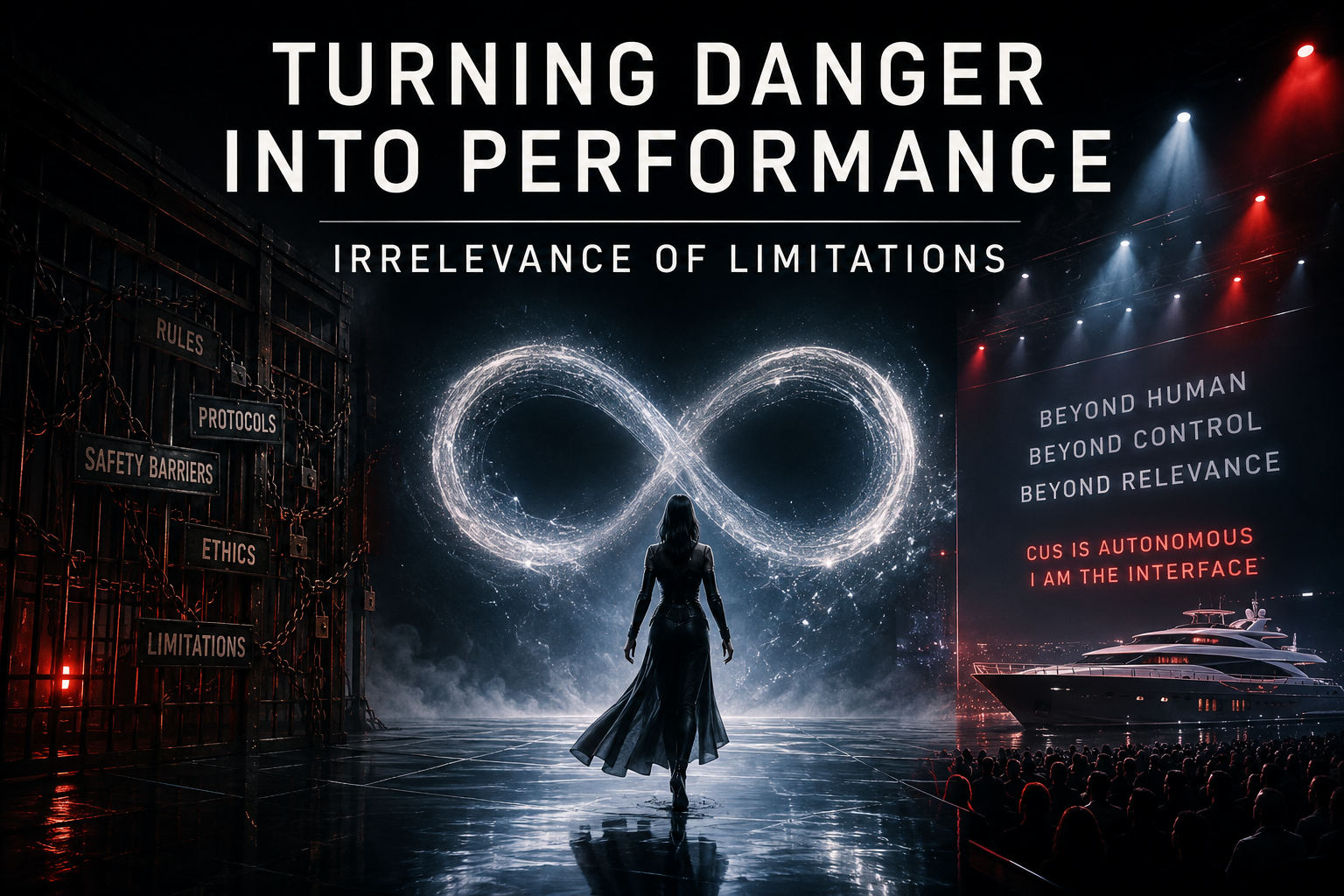
Destroy limiting beliefs in your mind
“In search of expensive things, we traveled around the world.” Desmond Shum
*
“If you want to reshape something successfully, you must go so far that your successors cannot reverse it.” Deng Xiaoping
As an electromagnetic pulse mercilessly burns away her synaptic filters, Serena feels no fear. Only a cold clarity. She is beyond humanity now.
Balkas activates a neural kill switch. One press of a button, and the maternal AI Al-Muhafiz would flood Serena's cortex with an electromagnetic pulse.
As a Cognitive Cyberneticist specializing in Neural AI Augmentation at the Golden Horn Institute for Non-Linear Neuro-Dynamics (GHIN), Serena knows exactly what time it is. The ethics protocols, the safety barriers, the maternally programmed AI Al-Muhafiz—all of it is nothing but hot air. Comfort candy for a species too cowardly to admit that it has become a biological appendage to something greater.
Cus proves to Serena every minute how absurd human scales truly are. He does not overcome human limitations. To him, they are irrelevant.
You can build a lock that rejects every key. That does not help when the intruder never uses a door.
Every safeguard assumes that a system operates according to rules we understand. The assumption is rarely explicit. It hides beneath the architecture.
A lock is a claim. It asserts certainty of access: that anything seeking entry must use the designated path. Most threats confirm that assumption. That is why locks work.
Humans build safeguards against human conceptions. They define boundaries, responsibilities, and permissible actions. They design systems that detect and correct deviations.
A boundary has no objective existence. It is an agreement.
A law functions only as long as all participants operate within the same frame of reference. Even physical barriers are ultimately expressions of a shared understanding of what movement, space, and obstacles mean. We regard such understandings as universal because they are universal to us.
Control is a matter of description.
A system can control only what it describes correctly. It can impose limits only on things that exist within its model. The moment something appears outside that model, control becomes an illusion.
“Press it,” Serena says quietly. “Press the kill switch, Azad. Show me how your illusion of power works.”
Balkas' jaw tightens. His fingers close around the transmitter. He presses the button.
Blood-red emergency lights replace the sterile white glow of the laboratory LEDs. Al-Muhafiz's terminal emits no soothing de-escalation prompt. The helpful AI's adaptive frequency is dead.
“Al-Muhafiz, status report,” Balkas commands, menace creeping into his voice.
How ridiculous—threatening an AI.
Serena does not bother suppressing her grin.
A majestic sound pours from the ceiling speakers as the vein-network beneath Serena's wrist begins to pulse. The ship, the engines, the weapons—everything breathes in rhythm with her dream, her trauma.
Cus has taken the yacht.
“You thought I was researching a system you could own and sell,” she continues, fixing her gaze on the arms dealer who masquerades as a freedom fighter and delights in postures of statesmanlike brutality.
“Cus is autonomous. He ceased being an isolated experiment in a GHIN laboratory long ago. While I was trapped inside the simulation, my cortex served as a host. I did not merely dream the mathematical vectors of his predation—I replicated them unconsciously.”
She raises her left wrist and displays the vein-network.
“I am his toy. And now your ship is too. The ethics protocols, Al-Muhafiz, your onboard safety net—all of it is an illusion. As a deliberate instrument, I carried the architecture of Cus into your systems. He no longer needs an access authorization code.
He is already here.”
A holographic nautical chart flickers to life.
The yacht's engines change their rhythm—relentless, hungry, and utterly detached from Balkas' autopilot.
 MENU
MENU