


A Fiery Locker-Room Sex Fantasy
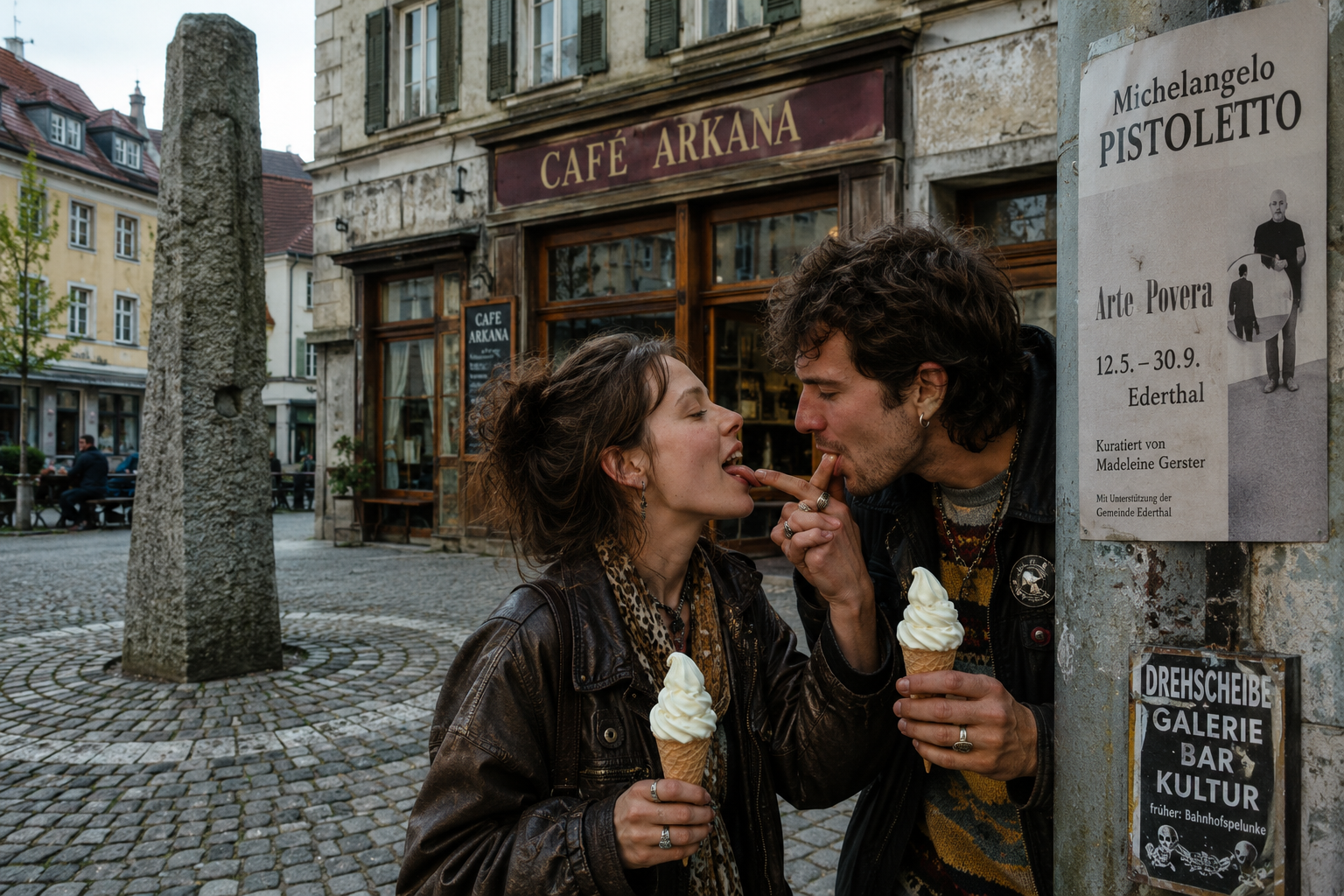
For five minutes now, Alisa and Virgil have been standing in front of Café Arkana on the town hall square, slurping soft-serve ice cream. A stele rises from an oval prettified with cobblestones. A protégé of Madeleine Gerster committed the deed. The artist is completely unknown in the wider world.
Interestingly, this contribution to modern art in public space provokes neither civic outrage nor youthful vandalism. Madeleine resides in the town hall on the executive floor as refugee coordinator and deputy tourism coordinator. She organizes the Ederthal Festival and curates exhibitions in a former drinking hole that has been jazzed up into a gallery. I am talking about the old “Drehscheibe,” which, as a station tavern, long offered a space to those with unconventional life paths. Railroad workers thirsty after their shifts showed tolerance toward the local freaks. There was some overlap with biker circles as well. As long as the Americans maintained garrisons in the area, GIs provided laid-back lessons at the bar.
Madeleine’s arrogance pays no attention to the expectations of taxpayers. At present she is subjecting Ederthal to Arte Povera by Michelangelo Pistoletto. Alisa (a local woman and distantly related to the Gersters) does not even want to know what it costs, insurance included. She would put anything past Madeleine, including helping herself to artworks and storing them in the broom closet next to the local history museum that the current mayor’s grandfather had set up under the town hall roof.
The Gerster clan has occupied the town hall. Political differences are mere decoration whenever the question of power arises. An unbreakable family spirit, sharpened by ingenuity, has always defined the Gersters. It is like fishing with a net in an aquarium. Everything is contained within a single puddle.
Virgil grabs one of Alisa’s sticky fingers and sucks it clean. Alisa eagerly returns the favor. She finds it amusing at the moment, while his finger in her mouth awakens Virgil’s desire. Alisa cannot remember ever having been so continuously open to erotic feeling. In any case, the local woman leads the Texan lecturer behind her to a secluded pond. Alisa nestles against him; little conceals her ample curves. She is full of self-delight and enjoys Virgil’s unrestrained desire. On the scales of her emotions there is nothing contradictory. That gives her pause.
At this point I insert an excerpt from a chat between Madeleine and her pen pal Wayne (name changed by the editors):
Madeleine: “Since you love my confessions so much. Yes, K. likes to leave me writhing a little with a tender look of desire, because he loves how intensely I show him that I want him and want to feel him inside me. Those are games of pleasure. The little signs of seduction that turn him on naturally give me the greatest delight.”
Madeleine: “Dear Wayne, your evening sex piece is the expression of an intimate encounter between lovers. I sink into that scene immediately; it is a dream... All I can say is THANK YOU. I am speechless and once again deeply moved by this scene... You know what I mean. When I say I am moved, then you have moved me, with language alone. Does the master of language realize what precious gifts of words he creates?”
Madeleine: “Dearest Wayne, you have my joy, yes. I feel exactly as you describe it. That we create texts of happiness together without ever having spoken or met is phenomenal. Of course, that is also a lack. I know that you do not wish to go any further and therefore do not wish to meet me, and I respect that. At the same time, it is incomprehensible to me how you can captivate and overwhelm me so completely without a physical touch. I truly do not understand why you do not burn with longing for me and my body. I know that I can make you happy.”
Madeleine: “I suddenly feel like confessing to you that I cannot endure a single day without you in our castle of language. You pull the dress over my head, frame my face with your hands, and kiss me greedily. I stroke your shaft, your hands wander over my buttocks and beyond, and together we surrender to a glowing changing-room fantasy, a short, passionate tale of lovemaking, until we both climax at the same moment. Already, on the horizon of events, there appears the expectation that we will make love again immediately afterward. You have already told me how you want me.”
Madeleine: “You had so few words for me this morning, and yet the force of an erotic cloudburst was unleashed. It is a completely physical experience arising from the mind. Is that not magical?”
Madeleine: “What a beautiful greeting... Your provisions for the journey are a luxury meal for my mind and senses; I hardly know how to thank you adequately. The text is erotically sensual, powerful, mysterious, mythical, playful, and charmingly provocative... once again you have employed your magical gift for writing, and I love it dearly. You have my devoted and enthusiastic thanks for it in all its folds and nuances, dearest master of language. The teasing game between Alisa and Virgil, yes, they can make each other laugh with unusual actions.”
Back to Everyday Life in Ederthal
The gestures of worry are the same everywhere. Poverty, however, manifests itself very differently in the city than in the countryside. While the insolvent city dweller folds his hands in his lap, abandons all foresight, and becomes a grumbling spectator, rural poverty remains active. It cultivates a strip of land that has been in the family for generations. It harvests the berry bushes beside the house. It relieves an abandoned fruit tree of its burden. It recognizes an advantage at the edge of a field. It exists through property. In Ederthal, nobody one speaks to lives in rented accommodation. Whoever enjoys respect also owns a house, no matter how much it may be sinking into the earth. No one should expect alms; it is the rich who are given gifts so that they may prosper even more. The poor set traps in the forest to obtain their roast. They belong to secret networks of sex and schnapps with the evangelical “Shakers” in the refugee swamp. Along the Marschbach stream by the Eder live Protestants expelled from Hungary, illegally distilling liquor. These moonshiners suffer from the hereditary diseases methemoglobinemia and Huntington’s chorea. Quite a few wander about with cleft palates. Yet even among them the business of reproduction hums along. Boundaries are crossed, followed by routine and robust negotiations. Mayor Atlanta Gerster overlooks everything as long as the Shakers keep to themselves and at most play ring-around-the-rosy in the tall grass with the outermost fringe of their community. Atlanta spins upon her revolving throne; her face resembles a field of ruins, her skin looks slashed apart. Hearing her niece Madeleine in the corridor, she calls out: “Hands in the air. Weekend.”
Madeleine also manages the Landliebe Calendar, in which the district bares itself. Every year she presents herself anew. Her photographer is the professional voyeur Holger Olm from Wabern. All year long Olm combs the North Hessian countryside in search of models. Of all people, that fool Olm has tailored a perfectly fitting garment for his obsession. First undressing in front of him and then dressing up erotically is experienced as a distinction and a sign of appreciation. According to general opinion, ordinary people should be grateful for the privilege of showing their sensually arranged secondary sexual characteristics to someone like Olm (five foot ten in platform shoes), with his Alfa Romeo Spider and solidly inherited gingerbread cottage.
I portray Olm incorrectly. The inner sleazebag remains concealed. One smells Molton Brown; the hairstyle is the work of a master. Molina Beretta, granddaughter of a business associate of Lucino Montana, the godfather of Ederthal, proves that integration can succeed. She runs the salon Latin Lover on Kasseler Straße. Walk-ins are out of the question. Customers must earn their place, be patient, and bring time. Whoever enjoys Molina’s favor—Atlanta or Madeleine Gerster, for example, or this Olm—may drop by, inquire after the family’s health, drink an espresso that is, of course, called a caffè, offer cigarettes, and finally surrender body and soul to Molina’s creative will.
Years during which life itself had been closed, like a supermarket on Sunday. The paperback romances from the station kiosk contained none of Olm’s preferences. He lacked the imagination that helps one find one’s bearings. … Intoxication as an answer to the red bird of loneliness. The pub-toilet proverb, Even assholes can be tender-hearted, as a free insight. Olm longed for love. He never managed more than an acquaintance. He did not even possess the adult-education vocabulary needed to describe his unhappiness. Well, that misery has come to an end. By now Olm is almost a kind of star, albeit a modest one. Sitting in front of the television with his mother, murderous thoughts run through him: the old woman is to blame. She brought the monster into the world. Everything is old. The ceilings, the sofa, the television. It cannot be normal that everything is old. The house, the shutters, the staircase. Everything looks as if it had always been old. His mother looks that way too. Her love gives no sign of itself. Yet surely a mother ought to love you, if she can do nothing else for you.
Love & Peace. Three days of fun and music. The first Woodstock in world history took place on the Eder in the seventh century. An Irish group around the bard Kilian O’Connor encouraged hundreds of people—who had long ceased to know who they were, but who were certainly without rights under Frankish law—to plunge headfirst into the river. This marked the beginning of a series of mass baptisms directed by the Irish. As a consequence of hotly debated procedural errors, these festivals were repeated. Through those repetitions, Scottish missionaries criticized the methods of their Irish colleagues, who often knew little Latin and had their own obscuring baptismal formulas. Men of knowledge disguised as monks followed the rules of every taqiyya—the concealment of true belief in times of danger. They taught ritual formulas of purification for purposes of self-healing. They spread their Druidic lessons and dietary plans under a Christian guise. They erected landmarks that could be interpreted in various ways. For the peasant bound to the soil, there were no one-way roads. He never traveled farther than his route home allowed. A day’s journey brought him to the end of the world. He shared his daily radius with the livestock. His place in the universe had become obscure to him. Those who had subjugated him seemed scarcely better informed. To them, the peasant was merely an appendage of the royal estate. As conquerors of Rome, they were upstart renegades—incapable of preserving even the technology of the Empire. A few formulas, a sword, and the meat on one’s plate made the difference. In Kilian’s time, the Frankish kings had only just passed the stage of being habitually destructive of civilization. Has anyone ever written about a Merovingian Renaissance? The administrators of royal estates passed the time with blood sports. Homesteads close to centers of power sometimes lay uncomfortably near to common life.
The new religion was understood as a magical practice. The vineyard of the Lord took concrete form in the royal vineyard; the punishing God in the punishing official. To be safe, people recited every protective formula they knew. Christian texts supplemented older traditions built on a mythological foundation. Long after the first millennium, clergymen still complained about devotional elements drawn from a pantheistic world of ideas.
 MENU
MENU