

Not a single day passed in which Aslan did not harden his body. At all times he carried a stick with him, with which he struck his shins, his thighs, and his chest. He often asked students to hit him as hard as they possibly could, even on his back and arms. Since he never commented further on the practice and did not lead Aiko down any secret paths in that direction, she restrained her curiosity and kept every question to herself.
In her perception, Aslan existed in two versions. She knew him as an open-hearted and generous man, as well as an incomparable—indeed almost magical—lover who bestowed upon Aiko pleasures unlike any man before him; more than that, he allowed her to experience peaks in the heavenly realm of cosmic ecstasy. Yet there was another side to him as well—closed-off and sullen. But Aiko was honest enough with herself not to conceal the fact that the mysterious Aslan, with his Oriental clan mystique, fascinated her—and aroused her.
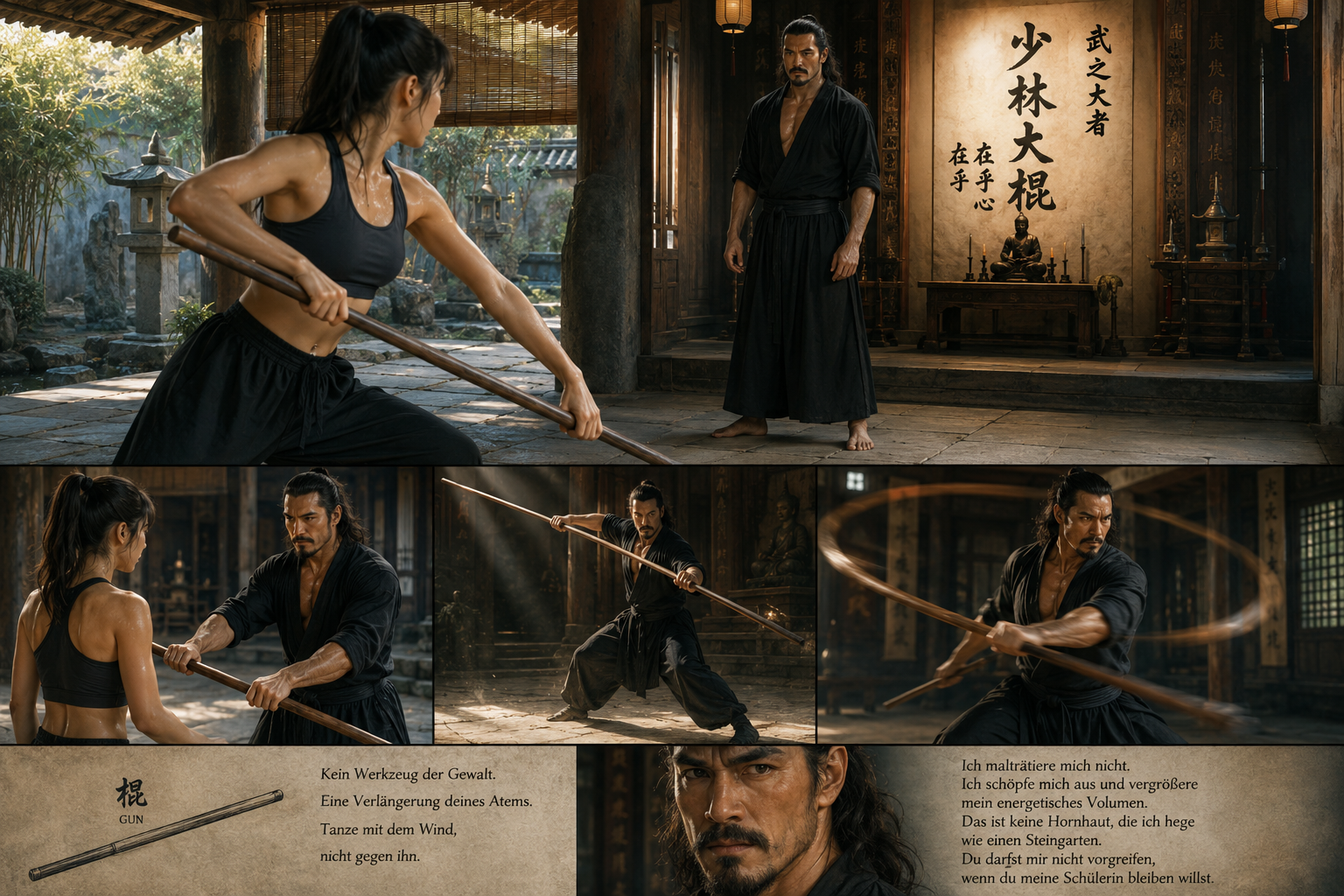
For several weeks, Aiko had been secretly conditioning herself with a Chinese fighting staff. Though not secretly enough. One afternoon, Aslan caught her in the act. He approached without a sound. Aiko noticed him only when he spoke to her.
“Aiko, in imperial China, the gun was regarded as the father of all martial arts. It is not an instrument of violence; rather, it is an extension of your breath. Learn to dance with the wind, not against it.”
Aslan took the staff from the novice and guided it through flowing movements, vast circular arcs, and impossibly fast spins.
“This is Shaolin Da Gun—the great form,” he explained. “When I train myself with the staff, it is out of love for the form. I do not abuse myself. I draw myself out and expand my energetic volume. It has nothing to do with self-harm. This is not callus that I cultivate like a rock garden. You must not anticipate my path if you wish to remain my student.”
Aiko was startled by the intensity Aslan deemed necessary. A profound sorrow seized her. She wanted to apologize, but the words failed her. She was simply grateful that Aslan refrained from any further instruction and instead liberated her through a shared meditation.
Later, he presented a gun from the era of Bodhidharma. The Indian monk is considered the founder of Shaolin martial arts through the practice of Yi Jin Jing—the transformation of muscles and tendons. The Khan also possessed a gun from the arsenal of Zhi Yuan, a warrior monk of the Ming period who had risen to the rank of commander.
The very next day, he resumed the staff lessons. He presented Alisa with an ancient Japanese fighting staff of legendary value. Bōjutsu is the Japanese term for staff fighting.
“The bō is humble, yet adaptable. It is about controlling distance. Whoever determines the distance decides the outcome of the damage.”
Aslan was among the adepts of the Shintō Musō-ryū school. Using the staff, he told Aiko a story. It was the tale of a monk who defeats a tyrant’s henchman, a man feared throughout the land as a master swordsman. The essence of the lesson was this: intelligently chosen angles, changes of tempo, and a clear mind offer greater strength than any display of martial weaponry.
“Power lies in the moment of decision.”
There it was again—the absolute presence of mind. Aiko was so captivated by her master that she could hardly wait for the end of the lesson. Aslan savored the overflowing passion of his student. He pushed her beyond every point of controllable pleasure…
 MENU
MENU